
Pressing · 4-2-3-1 and 4-3-3 · Master sessions
How to Press Center Backs With Your Wingers Without Leaving Their Fullback Free
Why we keep reinventing our pressing sessions, and the four-exercise session we now run every time the topic comes back around.
What’s your master session for pressing a build-out?
Most coaches would be confused by the question. Master session? They have a session. Probably a different one every time the topic comes up.
That’s how most of us coach. We plan a session, run it, decide it went well or it didn’t, and move on to the next day. A few months later the same topic comes back around and we start from a blank page again.
But most seasons we cover the same topics two or three times. Pressing. Building out. Defending crosses. So why are we reinventing the session every time?
Jerry Seinfeld doesn’t write a joke once and walk away. He works a few notes into a page, takes it in front of an audience and watches whether they laugh. Then he goes back, rewrites it, and tries it again. He keeps doing that until the bit works, and then it’s locked in.
Your players are your audience. After every session ask yourself two things. Did it work, and why? And by the end, could the players do it on their own? If not, figure out why, change the session and run it again the next time the topic comes up.
Do that for a few seasons and you stop planning from scratch. You end up with a library of sessions you have actually mastered. Here is one of ours.
The problem: pressing with one 9
When a 4-2-3-1 (or a 4-3-3) presses with only one 9, a team that builds out can move the 9 to one side of the field and free up the other center back, who can then carry the ball forward with no one pressuring him.
Bringing the 9 all the way back across rarely works. If the opposing team switches play quickly, or the center back carries forward fast enough, the 9 cannot recover. So you press the free center back with a winger or with a midfielder, and either option leaves a player free. If the midfielder steps, their midfielder is free. If the winger steps, their fullback is free.
The fix: the fullback steps, the line shifts
When the winger steps to the center back, the fullback on that side steps to their fullback, and the entire back line shifts across behind him.
The back line has to shift because the fullback who stepped had a winger of his own to defend. If the line doesn’t move across, that winger is left alone for a ball in behind. In the exercises below, the small goals behind the defenders represent that winger.
- Anticipation of the press
- Visual cues of the press
- Closing angles
- Speed of play
The session: 4 exercises, 86.5 minutes
The session starts with a breakout rondo, moves on to an expanded breakout rondo, then a 7v7 breakout game with 6 small goals, and ends with a 3-3-1 vs 2-3-2 game. It takes place in the middle third of the field.
1. 5v5 with 3 Small Goals
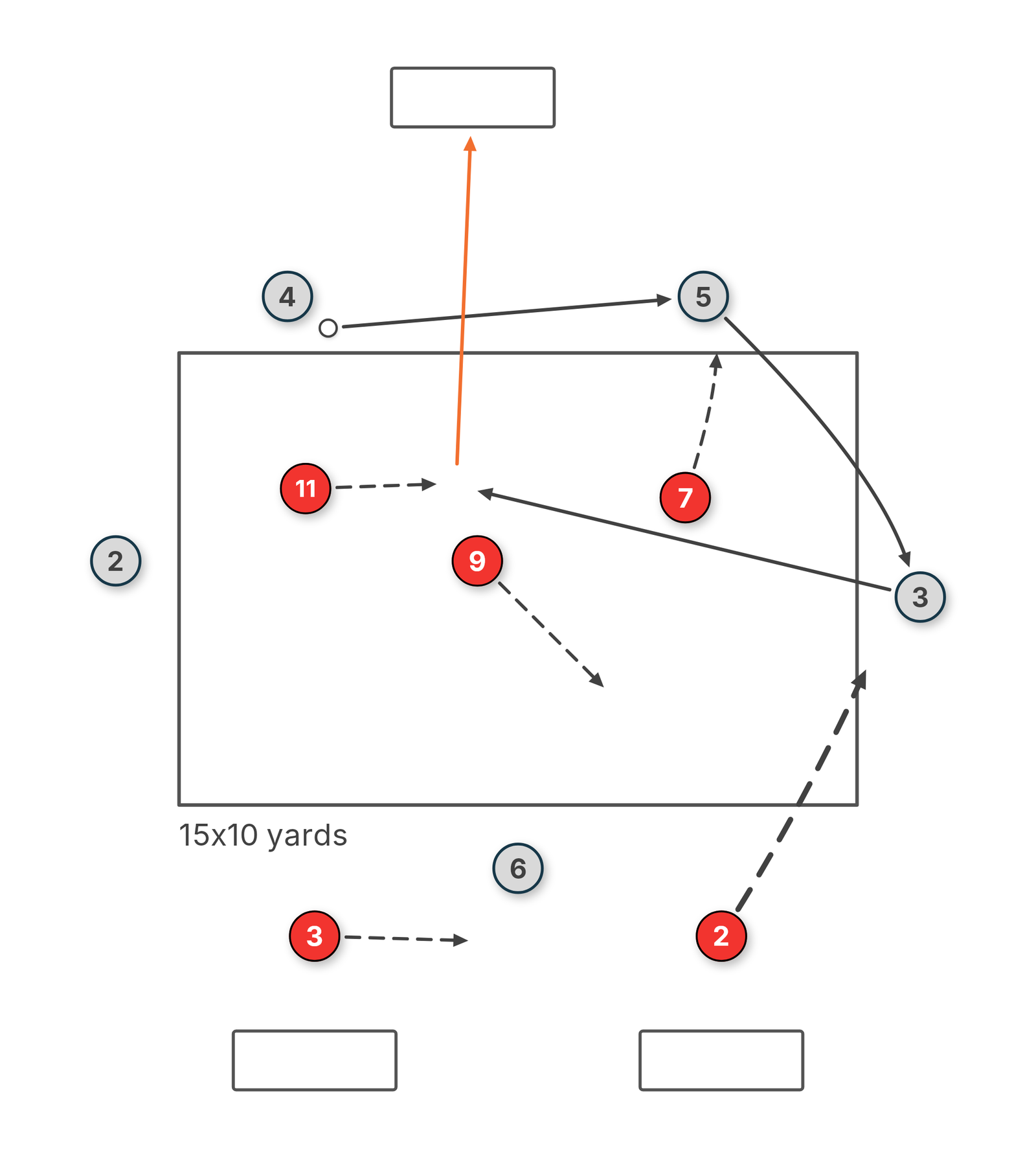
Your 11, 9 and 7 press inside the grid while five opponents move the ball around the outside. Your fullbacks guard 2 small goals behind the grid. The opponents can score there after 3 passes, and a defender’s touch restarts the count. When the ball goes to their fullback, your fullback steps in to press and the other fullback shifts across.
Coaching points: angle of press, time of press, communication.
2. 6v7 Plus 2 with 4 Small Goals
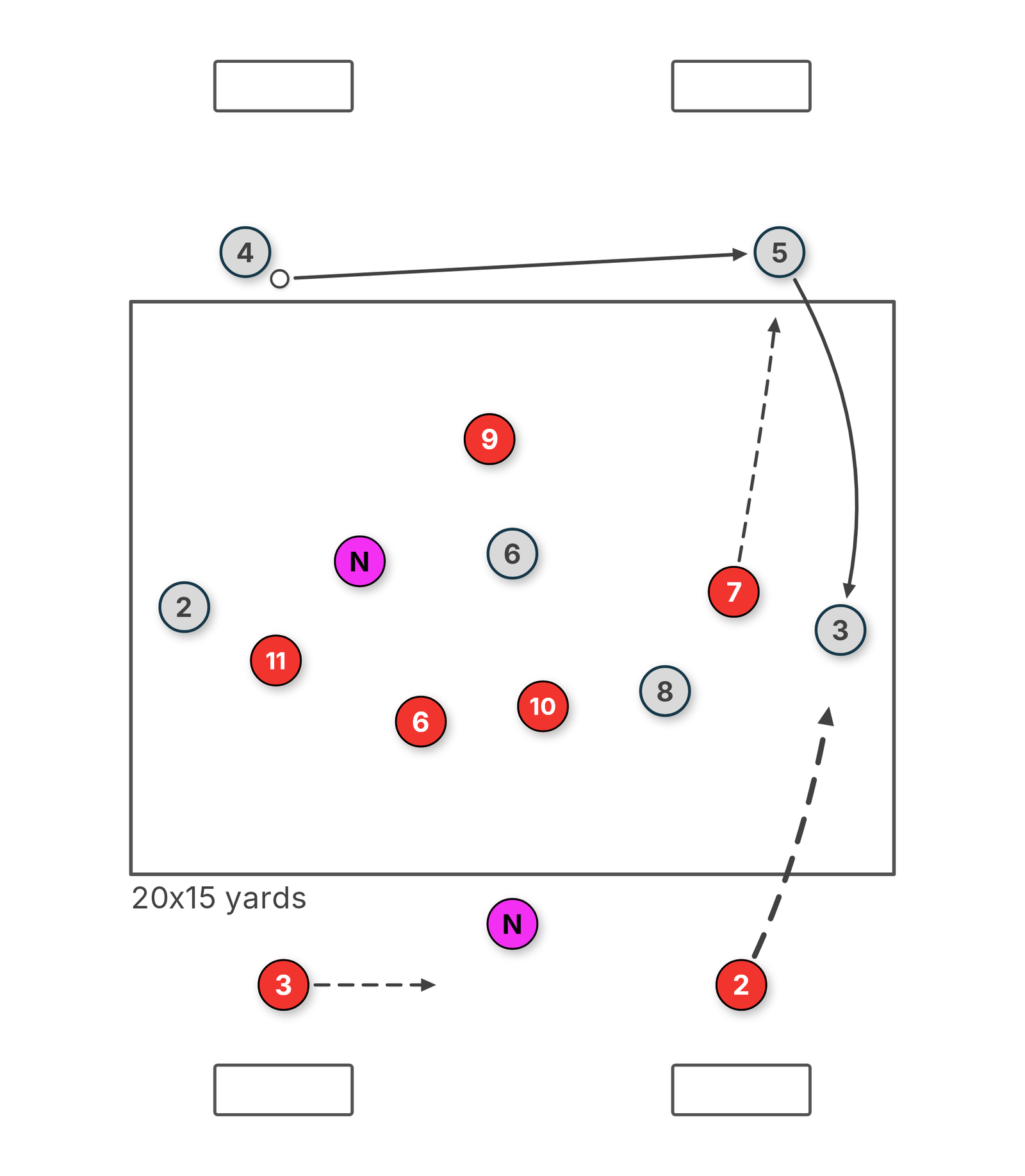
Their center backs start outside the top of the grid, and you can press them there. When your winger presses a center back, the fullback on that side steps to their free fullback, and the other fullback shifts across to help shield that goal. Win it, and attack the 2 small goals up top.
Coaching points: timing of press, angle of press, communication.
3. 7v7 with 6 Small Goals
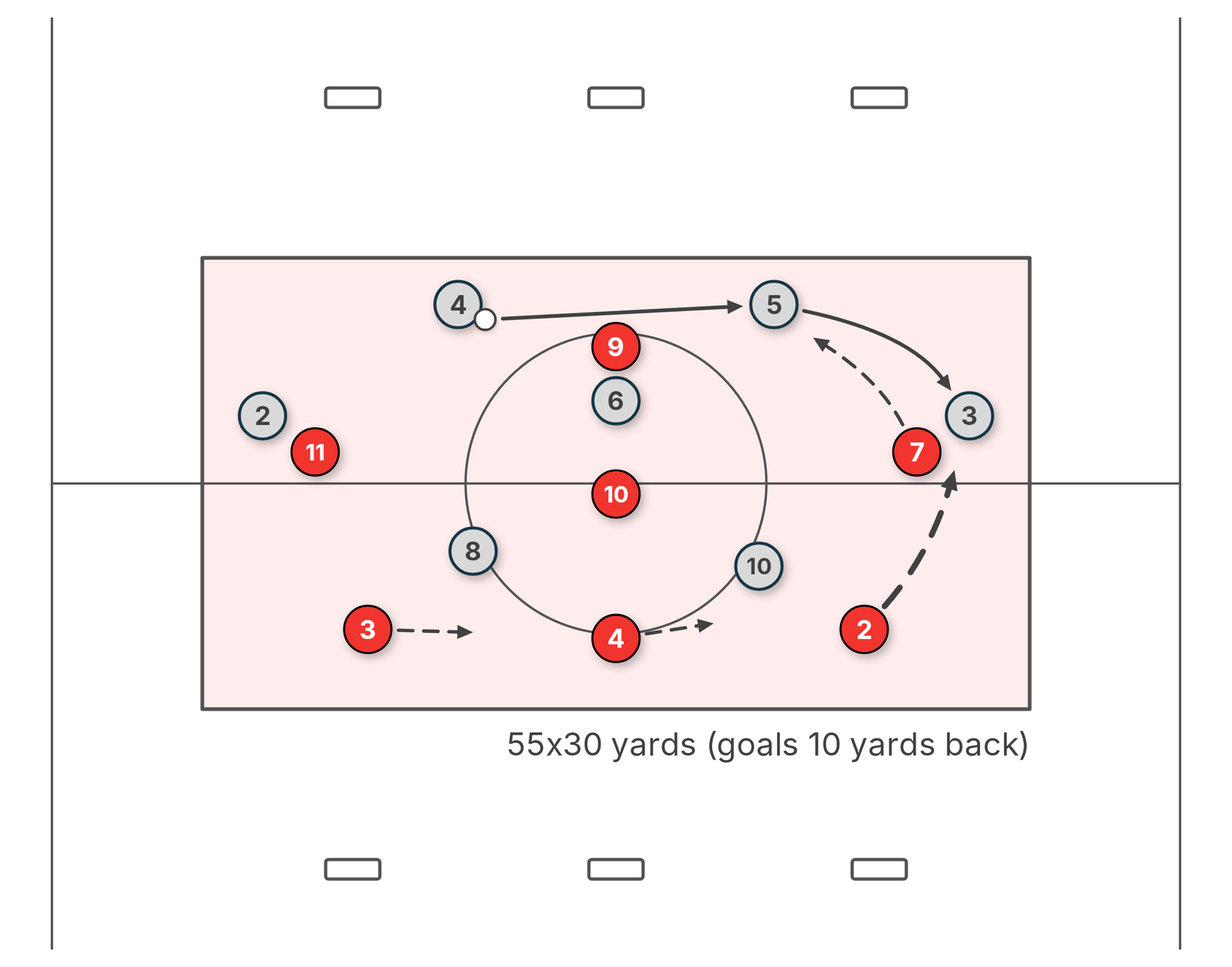
The opponents can break out of the grid after 3 passes. You break out as soon as you win it, by dribbling or with a penetrating pass. Watch the moments your wingers press the center backs, and use the free defender to jump to the strong-side fullback.
Coaching points: timing of press, angle of press, speed of play.
4. 3-3-1 vs 2-3-2 Game
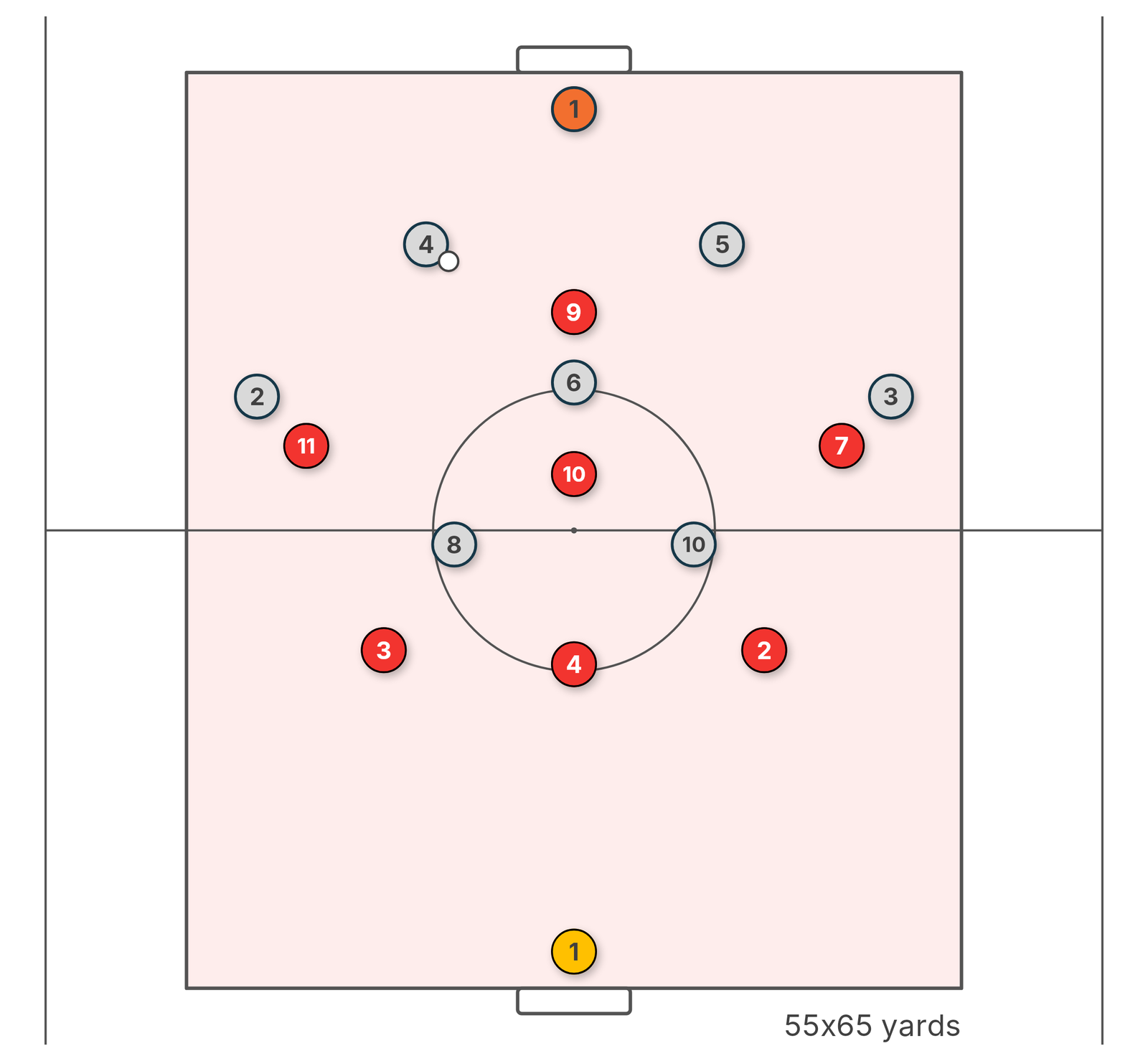
Two large goals with goalkeepers. Win the ball back as quickly as possible and counter to goal. Pay attention to the moments the winger steps to the center back.
Coaching points: timing of press, angle of press, speed of play.
Make it your master session
Run it once and ask the two questions. Did it work, and why? Could the players do it on their own by the end? The session already has some adjustments built in: in exercise 1 you can make the grid larger and put a neutral inside, and in exercise 2 you can take the neutral out of the middle if it is too easy for the opponents to score. Change what needs changing, run it again the next time pressing comes up, and keep the version that works.
The full session, with setups, timings, equipment and variations for all 4 exercises, is free to print.